Futon History
The futon mattress was invented in Japan.
However, the futon sofabed was invented in Cambridge. William Brouwer created it in 1982. Bedworks first introduced Brouwer's invention to the world.
William Brouwer spent time in Japan and loved Japanese design. He had studied at the Harvard Graduate School of Design; he was a fine woodworker & designer. Brouwer slept on a futon mattress on a low platform bed of his own design. Brouwer was already handcrafting these beds for Bedworks.
One day in 1982, Brouwer had a brainstorm: He knew futons are flexible: the Japanese roll them up every morning. If futons are flexible like a piece of paper, then folding them into sofabeds is simple origami. Brouwer hinged a double bed width-ways in three clever pieces. Presto! Brouwer had devised the folding futon sofabed! Brouwer had his woodshop at 9 Montague St., 400 yds. down Western Ave. from Bedworks. Now years later, people sleep on futon sofabeds all around the world, not just in Cambridge.
Brouwer's invention has circled the globe. Futon Sofabeds are made in Canada, the U.S., Mexico, Argentina, Brazil, Chile, Trinidad, Romania, England, Denmark, France, Italy, Spain, China, Malaysia, and Indonesia. Each country has woods of different strengths.
Frame Quality
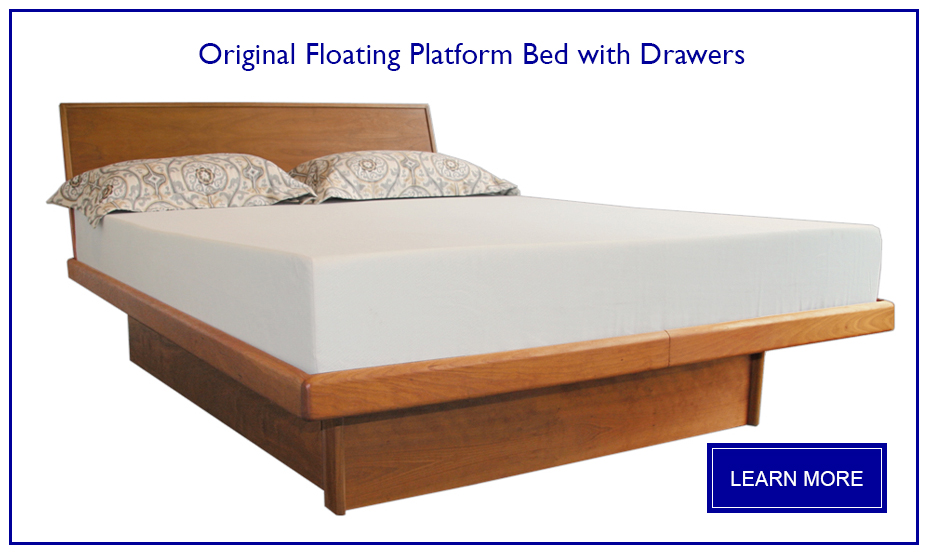
In 1982, William Brouwer invented and built the original folding futon frame in Cambridge, a few blocks from Bedworks. He handcrafted his futon frames in the strongest American furniture hardwoods: solid cherry, solid oak, solid maple and solid Bubinga (All of which we use today to build our Floating Platform Beds). They never broke.
Others in the U.S. tried to copy Brouwer's invention in cheaper, softer woods like pine and spruce. They broke.
Then factories in Asia offered folding futon frames … in still-cheaper rainforest soft woods and thin black metal tubing. They broke. These weak Indonesian wood and Chinese black metal frames are what most stores sell today.
Over the past 25 years, Bedworks has tested all these woods. We are clear: The only woods strong enough to be folding futon frames are temperate hardwoods weighing at least 40 Lbs/ft
3 [i.e., 640 Kg/m
3]. Lighter woods will quickly break. European solid beech is the strongest futon hardwood that Bedworks has ever offered. Our rugged European solid beech frames carry our workshop's 20-year "won't break" warranty.
What to look for in buying a quality futon frame:
1.) Start with the Wood –
Your futon frame must hold 1000 lbs, of live load. That's three 200-lb. guys plunking down to watch TV, plus 150 lbs. of wood & mattress. Only heavy hardwoods – solid beech, ash and maple – are strong enough to qualify for our two decade-long no-problem guarantee.
At BedWorks, we've made & sold futon frames for 25 years, since Wm. Brouwer first invented them nearby on Western Ave. We introduced his design to the world in 1982. We've seen what works & what fails.
All of our futon frames with arms are made of solid Beechwood. Beech is a strong, durable hardwood that will stand the test of time. European Beech is stronger than Red Oak, White Oak and Silver Maple in 6 of 7 tested properties. 100% Beech (not various hardwoods) – ensures continuity of strength and durability. Our manufacturer uses reforested beech in all of its frames. Forests have been selectively harvested and replanted as a renewable resource for hundreds of years.
2.) Check the Construction –
All arms are mortise and tenon construction – a joinery method used to ensure strength and durability. Superior to dowel joinery. Joints are glued and pinned for additional strength at high stress points. All tops are doweled, glued, screwed and plugged. This prevents the tops from pulling off when frames are moved. Metal to metal construction – all arms are assembled to the stretchers with metal barrel nuts for strength. Frames convert on a durable nylon roller bolted through the back of the frame for smooth long lasting use.
3.) Examine the Finish –
A 6 step polyurethane finish gives all of our frames and arms a rich, durable long lasting finish.
Step 1 – stained;
Step 2 – sealed;
Step 3 – handsanding;
Step 4 – polyurethane coat;
Step 5 – second sanding;
Step 6 – final coat of polyurethane.
Ease of cleaning – all frames can be cleaned with a soft damp cloth; no polishing or waxing is needed.
4.) Ease of Operation –
All frames come with a 3–position locking mechanism.
Seated position – locks to ensure the frame stays upright and will not slide back from customer use or from the pressure of a thick premium mattress.
Lounge position – locks for comfortable reclining.
Bed position – Locks in position so that the ends remain secure for a good night's sleep.
EUROPE'S MOST COMMON HARDWOOD LUMBER:
The European Beech [Fagus sylvatica] flourishes as Europe's strongest and most widespread tree. It is called the "
Mother of the Forest" for the nutrient-rich humus it creates and "
Queen of the Forest" for its large size and stately appearance. The European Beech is a large tree, capable of reaching heights of 150' and trunk diameters of 9'. It is commonly 80-110' tall and 5' in diameter. It has a typical lifespan of 150 to 200 years. and it has a density of
WIDESPREAD:
Beech trees range across Europe, from the Pyrenees to the Carpathians, from Scandinavia to the Mediterranean. Specifically they flourish from Sweden to Sicily, from northern Portugal east through Italy and Slovenia to Poland, Romania, and Russia. Beech forests ring the northern Mediterranean in mountains from 2-6,000 feet altitude. Beech is more widespread in Europe than northern red oak in the U.S.
The Beech grows widely across Europe, as 29 languages attest:
| English | Beech | | Danish | Bøg |
| Frisian | Boek | | Dutch | Beuk |
| German | Buche | | Czech | Buk |
| Hungarian | Bükk | | Polish | Buk |
| Bulgarian | Byk | | Ukrainian | Byk |
| Swedish | Bok | | Norwegian | Bøk |
| Serbian | Bukva | | Slovene | Buk |
| French | Hêtre | | Spanish | Haya |
| Greek | Oxya | | Albanian | Ah |
| Latin | Fagus | | Catalan | Faig |
| Italian | Faggio | | Portuguese | Fago |
| Romanian | Fag | | Romansh | Fau |
| Basque | pago | | Manx | Faiigh |
| Cornish | Fawen | | Gaelic | Faidhbhile |
| Welsh | Ffawydden |
Our word "book" is derived from the Beech. Early Europeans named it the "buk" tree and wrote messages on its bark. They called their writings "boc", which became the German "Buch" and English "book".
USEFUL TREE
Europeans have relied on the Beech for several thousand years. In spring, its seeds provided lamp oil, a lubricant, and a wood finish. In autumn, its leaves were traditionally gathered and used as a stuffing material for mattresses. In winter, it supplied hot, long-burning firewood.
SPECIES
European Beech is widespread, common, and secure within its natural growth range.
REPUTATION
Beech is considered to be among the best-known and most useful commercial timbers in the world.
PHYSICAL PROPERTIES
European Beech is rated as hard, heavy, and high in resistance to shock, abrasion and wear. It surpasses American Red Oak, White Oak and Silver Maple in 6 of 7 physical properties.
APPLICATIONS
Fine furniture, dining chairs, flooring, millwork and paneling.
The wood of the European Beech is hard, heavy, strong, and very durable. Beech takes an excellent finish and is resistant to compression and splitting. Beech's extreme hardness is ideal for making wooden mallets and workbench tops. Beech is preferred for making chairs, beds, parquet flooring and staircases. Indeed, European Beechwood can do almost anything.
Click here to browse our frames made of European Beech.
INNEXPENSIVE WITHOUT BEING CHEAP
At Bedworks, we believe that quality is the most important part of what we offer. This does not mean a hefty price tag. WE have a couple futon frames and beds that are made of
Tulip Poplar, which is a wonderfully strong hardwood, that is not strong on the wallet.
Click hear to read about it.
WHAT WE DO NOT SELL:
"Kelempajan" aka Indonesian balsawood
Botanical Name: Anthocephalus cadamba
Natural Habitat:
Indonesian rainforests. It grows on deep, moist, alluvial sites. It thrives along riverbanks and in the transitional zone between swampy, permanently flooded and periodically flooded areas.
Wood Density and Characteristics:
Kelempajan weights only about 18 lbs./ft
3. Therefore, it is a very light, soft, weak wood. Kelempajan is much weaker than even American spruce, a softwood weighing 28 lbs/ft
3.
Wood Uses:
Kelempajan has poor dent and break resistance. It is commonly used for pulp, paper making, disposable chop sticks and play toys. As a light, fast-growing wood, kelempajan lumber is much cheaper than heavier, more durable Indonesian hardwood lumber. Indonesian factories regularly mix kelempajan with other woods when they make futon frames for export, obscuring the many different species under dark stains.
Futon frames in Indonesia and the Far East use soft rainforest woods. These soft woods are cheap, like soft pine.
Dozens of soft woods grow close together in rainforests. Factories can't easily separate the different species, so they process them all mixed together. The factories use stains to hide the different grains. Not just environmentally unfriendly, soft rainforest woods are excessively weak to survive as futon frames.
Why Do Black Bracket Futons Break?
Black Bracket Futons, aka Front Loaders, are merely Rainforest Futons festooned with a dozen black sheet metal brackets on their ends. Factories add these hoping to beef-up the cheap balsa-like Indonesian rainforest woods they use. They still break. Often. Ask us. We'll show you.
Why are Wallhuggers Not Friendly?
A Wallhugger is a 3-sided box meant to sit against a wall. The box doesn't move. The sofa pulls out the open side as a bed. The box encloses one side of the bed, plus half its ends.
Wallhuggers are asymmetrical, with lop-sided headboards & footboards. They can't be turned 90° to the wall to become beds like other futons.
Wallhuggers' most embarrassing problem comes when two guests sleep over. The box means that the inside guest must crawl over the other sleeper to go to the bathroom!
What Can You Do With A Broken Futon?
When soft wood futon frames break, you are responsible for bringing the broken part back to the store. The store orders a replacement part, if one is available. The new part can arrive in a different stain, two months later. Meanwhile, your futon is broken and unusable. Rainforest, Metal Bracket and Wallhugger Futons cause big headaches, even apart from rainforest extinction.
Rhino Tough Futon Frames
- Berry Pierre, Cambridge